Dry Cleaning Rack Management: A Guide for Laundromat Owners
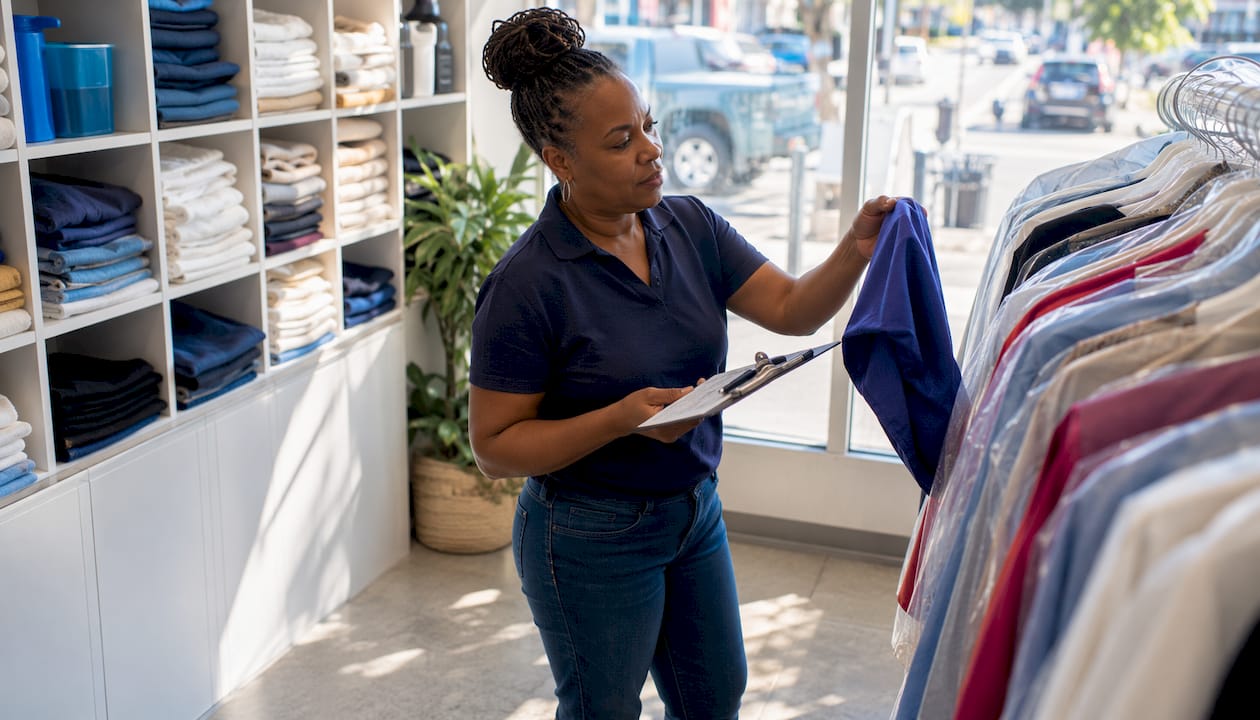
Dry cleaning rack management is the combination of physical garment storage systems (static rails, overhead conveyors, enclosed carousels) and the digital order-tracking software that tells staff exactly where every order lives, when to move it, and how to retrieve it without error. Get it right and you cut mis-picks, shrink turnaround time, and reduce the labor hours that quietly eat your margin every shift.
Key operational wins at a glance:
- Fewer mis-picks and lost-order disputes
- Faster order retrieval during peak hours
- Lower labor cost per order through reduced non-value-added steps
- A defensible paper trail when a customer disputes a claim
Automation in dry cleaning is increasingly treated by operators as a non-human employee: it performs repetitive tasks consistently, enabling predictable throughput without adding headcount. Kansoflow is built on exactly that logic, connecting your physical rack workflow to a POS that tracks every garment from check-in to pickup.
Table of Contents
- What rack system types actually fit your shop?
- The real business case: labor, throughput, and ROI
- How digital tracking connects to physical racks
- Implementation checklist: from layout to go-live
- Safety and maintenance: why enclosed systems win
- KPIs that tell you whether rack management is working
- Common pitfalls and how to fix them fast
- How to evaluate rack vendors and software partners
- How Kansoflow connects rack workflows to your counter
- Key Takeaways
- The part most owners get wrong about adoption
- See Kansoflow in action for your shop
- Useful sources
What rack system types actually fit your shop?
Not every shop needs a conveyor. The right system depends on your volume, floor space, and service model.
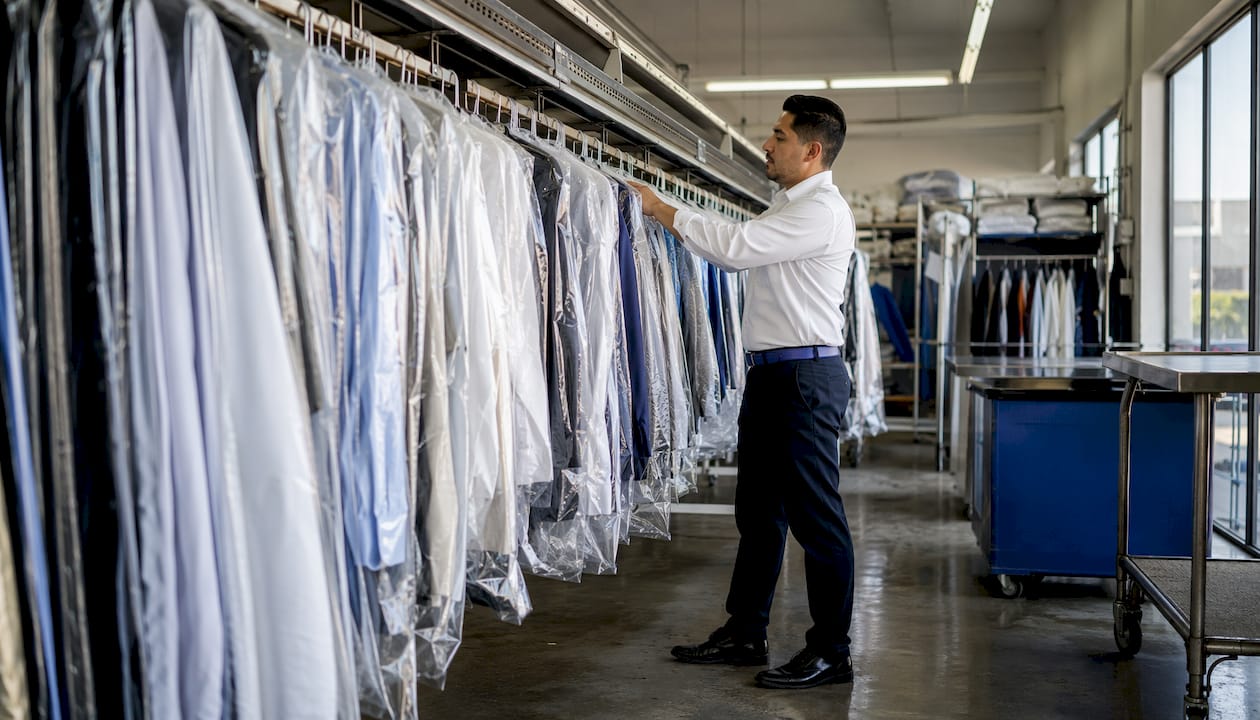
Static rails and Z-racks are the entry point. Low upfront cost, zero moving parts, and easy to reconfigure. They work for single-location shops processing fewer than 100 orders a day, but manual retrieval time adds up fast at higher volumes.
Open overhead conveyors move garments along a motorized track, reducing the steps staff walk per shift. Conveyors act as the arteries of a dry cleaning plant, improving access and cutting non-value-added movement. Mid-volume shops with typical daily orders in the hundreds generally see the clearest payback here.
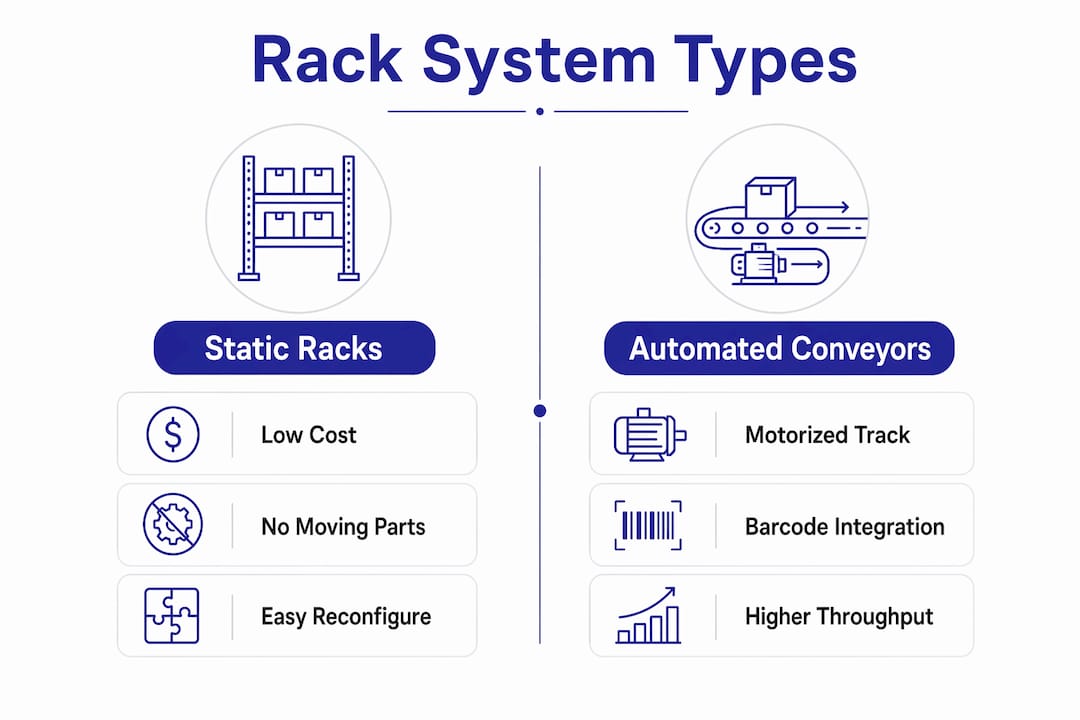
Enclosed automated conveyors and carousels add a dust shield, isolate moving parts from staff, and support barcode or RFID-triggered retrieval. Higher upfront cost, but garment protection and safety compliance improve noticeably. Enclosed-track systems are the preferred choice for cleanliness and staff safety in high-volume or multi-location plants.
Vertical and compact systems solve a specific problem: tight square footage with high throughput demand. They store more garments per linear foot but require more maintenance access planning.
Pro Tip: If your shop is in a strip mall with a low ceiling, an enclosed horizontal conveyor almost always beats a vertical system on long-term maintenance cost and retrieval reliability, even though the sticker price is higher.
Conveyors are modular and reconfigurable to fit tight corners and can expand as your business grows, so the system you install today does not have to be the system you are stuck with in three years.
The real business case: labor, throughput, and ROI
Every unnecessary walk, manual sort, or misplaced-order search is lost revenue. That is the core financial argument for investing in rack management, and it is not abstract.
Operators who adopted automation reported reductions equivalent to dozens of employees and dramatic increases in pieces-per-hour. Centralized plants saw significant gains, but independent shops benefit from the same mechanics at a smaller scale.
ROI calculation is straightforward. Take the labor minutes saved per order, multiply by your average wage, then multiply by weekly order volume. That number, compared against the system’s amortized monthly cost, gives you a payback timeline. The levers that move payback fastest are barcoding (low cost, immediate accuracy gain) and conveyor-assisted assembly (highest labor reduction per dollar at mid-to-high volume).
Automated systems also enable end-to-end garment traceability and 24/7 customer pickup via secure code-based access, which adds a revenue dimension most ROI models ignore.
How digital tracking connects to physical racks
The physical rack is only half the system. The software layer is what turns a conveyor into a retrieval engine.
Core integration patterns:
- Barcode tags or RFID chips on hangers link each garment to an order record
- Visual Kanban boards map order status to physical rack locations
- Photo intake at check-in ties a garment image to the order before it ever touches a rail
- Ticket and receipt printing with rack slot IDs tells staff exactly where to hang and where to retrieve
Example workflow:
- Customer drops off garments; staff creates an order in the POS
- System prints a barcode tag; staff attaches it to the hanger
- POS assigns a rack slot or conveyor stop to the order
- Garment moves through cleaning stages; each scan updates status
- At pickup, staff scans the ticket, conveyor routes the order to the retrieval point, and the POS confirms release
Barcode tracking is the foundational first step. Without it, conveyor automation and assembly systems cannot function reliably. RFID goes further: a single reader portal can scan an entire cart containing hundreds of items in under five seconds versus the lengthy manual counting it replaces.
| Integration layer | Hardware needed | Software function |
|---|---|---|
| Barcode | Label printer, handheld scanner | Order lookup, status update |
| RFID | UHF reader portal, RFID tags | Bulk scan, lifecycle tracking |
| Visual Kanban | POS screen or tablet | Drag-and-drop stage management |
| Photo intake | Camera or tablet | Claims defense, garment record |
Implementation checklist: from layout to go-live
Follow this sequence to avoid the most common rollout mistakes.
- Map your current layout. Measure peak-load garment counts, identify bottleneck zones, and note ceiling height and power outlet locations.
- Audit hanger and poly supply. Inconsistent hanger types cause conveyor jams. Standardize before you install anything motorized.
- Choose your tagging standard. Barcode is cheaper and sufficient for most independent shops. RFID makes sense when you process 300-plus orders daily or run a centralized plant serving multiple drop-off locations.
- Set up hardware integrations. Connect label printers (Kansoflow pairs natively with Star Micronics), scanners, and any conveyor PLC interfaces to your POS network.
- Run a two-week pilot. Limit the pilot to one rack section or one service type (dry cleaning only). Track mis-pick rate and average retrieval time daily.
- Train loaders on even distribution. Uneven weight on a conveyor causes wheels to jump the track, which is the single most common mechanical failure and the easiest to prevent.
- Set go/no-go KPIs before go-live. If mis-pick rate does not drop and retrieval time does not improve within the pilot window, diagnose before expanding.
The lowest-cost first step is always barcoding. Process changes and label discipline cost almost nothing and immediately improve order accuracy.
Safety and maintenance: why enclosed systems win
Daily inspection checklist:
- Check track alignment and listen for unusual motor sounds
- Inspect hanger hooks for bends that cause jams
- Verify poly bag supply and quality (thin poly tears and wraps around drive wheels)
- Confirm all emergency stop buttons are functional
Safety non-negotiables:
- Apply lockout-tagout procedures before any maintenance on a motorized conveyor
- Maintain overhead clearance control; mark restricted zones clearly
- Avoid inclined conveyors for retrieval-heavy locations. When an inclined system loses power, retrieving orders requires ladders and causes extended downtime, a liability no independent shop can absorb easily.
Enclosed systems reduce dust exposure on finished garments and keep moving parts away from staff during normal operation. That combination improves customer perception and reduces your workers’ compensation exposure.
Pro Tip: Schedule a full lubrication and track-alignment check every 90 days. Most conveyor failures that require a technician call trace back to skipped quarterly maintenance, not equipment defects.
KPIs that tell you whether rack management is working
| KPI | How to measure | Independent shop target | Centralized plant target |
|---|---|---|---|
| Average turnaround time (TAT) | POS check-in to ready timestamp | 24 hours | 12 hours |
| Mis-pick rate | Claims or re-pulls per 100 orders | Under 2 per 100 | Under 1 per 100 |
| Labor minutes per order | Time-tracked staff minutes / order count | under 10 minutes | 4–7 minutes |
| Throughput | Pieces processed per staff hour | around 20 pieces | around 50 pieces |
| Return/claims rate | Customer complaints per 100 orders | Under 1 per 100 | Under 1 per 100 |
Measure TAT and mis-pick rate first. They are the fastest indicators of whether your rack system and digital tracking are actually working together.
Common pitfalls and how to fix them fast
- Poor labeling discipline: Tags fall off or are skipped during rush periods. Fix: make scanning mandatory at intake, not optional. If the system has no scan, the order does not move forward.
- Uneven conveyor loading: Heavy orders clustered together cause wheel-jump events. Train loaders to distribute orders evenly across the track and run spot checks during peak hours.
- Wrong hanger types: Wire hangers from outside orders jam enclosed conveyor tracks. Standardize to one hanger specification and post it at the intake counter.
- Barcode mis-reads: Usually caused by wrinkled labels or low-contrast printing. Replace the label batch and check printer calibration. This is an in-house fix; no technician needed.
- Power outage on an inclined system: This is a technician call. Do not attempt manual retrieval without proper equipment. This is the strongest operational argument against inclined conveyors in the first place.
Pro Tip: Keep a small stock of pre-printed replacement tags at every scanning station. A mis-printed label that gets re-done in 30 seconds beats a garment that moves through the system untracked for an entire shift.
How to evaluate rack vendors and software partners
Questions for rack-system vendors:
- What is your uptime SLA and average service response time in my region?
- Are parts stocked locally or shipped from overseas?
- What does the installation and training package include?
- Can the system expand modularly if my volume doubles?
Software and POS partner criteria:
- Native hardware drivers for label printers and barcode scanners (not browser-based workarounds)
- Visual Kanban with drag-and-drop stage management
- Photo intake tied to each order record
- Multi-location enterprise features for inter-branch transfers
- Offline mode so a network outage does not stop your counter
Simple ROI model:
- Count labor minutes saved per order after the system is running
- Multiply by your average staff wage per minute
- Multiply by weekly order volume
- Compare against the system’s monthly amortized cost
That payback period is your decision threshold. Most independent shops that start with barcoding and a Kanban-based POS see payback within the first year. Reviewing your cash discount program alongside POS integration costs can further reduce your net monthly outlay.
How Kansoflow connects rack workflows to your counter
Kansoflow’s platform features map directly to the rack-management wins described above.
- Visual Kanban board: Drag-and-drop order stages (Wash, Dry Cleaning, Ready) give every attendant a live view of where each order sits, without walking the floor.
- Photo intake: Garment photos taken at check-in create a timestamped record that shuts down most lost-item disputes before they escalate.
- Label and tag printing: Native pairing with Star Micronics printers means barcode tags print at the counter in seconds, not after a browser refresh.
- Enterprise branch management: Drop-off locations transfer orders to processing hubs with full tracking, so multi-location owners see the full picture in one dashboard.
- Deep hardware integration: Bluetooth scales, receipt printers, and Stripe/Square payments run natively on iOS, with no proprietary hardware bundles required.
Pro Tip: Kansoflow’s tutorial library on YouTube covers counter setup and Kanban configuration in short videos, which cuts new-staff training time significantly compared to reading a manual.
Key Takeaways
Dry cleaning rack management works when physical systems and digital tracking operate as one connected workflow, not two separate investments.
| Point | Details |
|---|---|
| Start with barcoding | Barcode tagging is the lowest-cost first step and the foundation every other automation layer depends on. |
| Match rack type to throughput | Static rails fit low-volume shops; enclosed conveyors pay off at mid-to-high volume or multi-location plants. |
| Track three KPIs first | Turnaround time, mis-pick rate, and labor minutes per order tell you within weeks whether the system is working. |
| Pilot before full rollout | A two-week pilot on one rack section surfaces loading, labeling, and integration problems before they scale. |
| Kansoflow ties it together | Kansoflow’s Visual Kanban, photo intake, and native label printing connect counter operations directly to rack workflows on iOS. |
The part most owners get wrong about adoption
The operators who struggle with rack management rollouts almost never fail because of the hardware. They fail because they treat the software and the physical system as two separate projects with two separate timelines. By the time the conveyor is installed, the POS still runs on paper tickets, and staff revert to what they know under pressure.
The pragmatic sequence is: barcode first, Kanban board second, conveyor third. Each step makes the next one easier to justify and easier to train. Multi-location owners especially benefit from this order because it builds a consistent process at one location before replicating it across branches. Simple UX matters here. If attendants need a manual to use the tracking system, adoption will stall the moment you are not watching.
See Kansoflow in action for your shop
Kansoflow gives independent and multi-location laundromat owners a single iOS platform that runs the counter, tracks every garment, and maps directly to your rack workflow without proprietary hardware or a browser-based workaround.
Ready to see how it fits your operation? Explore the full feature set or visit kansoflow.com to get started.
Next steps:
- Book a demo to walk through the Visual Kanban and photo intake setup
- Request the implementation checklist for your rack type
- Watch the counter setup tutorial on the Kansoflow YouTube channel
The iOS-native interface means your staff can learn the core workflow in a single shift, not a week of training.
Useful sources
- American Drycleaner: Using Automation to Ease Labor Concerns — Operator-reported data on labor savings, throughput gains, and the role of barcoding as the first automation step.
- American Drycleaner: Conveyors Essential to Production Flow — Covers conveyor types, loading discipline, inclined-system risks, and non-value-added step reduction.
- Bridgeveyor: 6 Advantages of Garment Conveyor Systems — Vendor overview of enclosed-track benefits, modularity, and safety advantages.
- Metalprogetti: Automated Systems for Dry Cleaners — End-to-end traceability and 24/7 customer pickup via automated carousel systems.
- Orgaearth: Garment Conveyor Systems — Industrial conveyor positioning for high-volume dry cleaning and laundry environments.
- Kansoflow Features — Full platform capability overview covering Visual Kanban, photo intake, label printing, and enterprise branch management.