Best WashDryFoldPOS.com Alternatives for Laundromats in 2026

What are the best washdryfoldpos.com alternatives for laundry businesses?
The strongest alternatives to washdryfoldpos.com are purpose-built laundry POS platforms that handle weight-based billing, pickup-and-delivery logistics, and commercial hardware natively. Generic retail systems like Square or Clover technically process payments, but lack laundry-specific features like per-pound pricing, garment tracking, and automated customer notifications, forcing owners into expensive workarounds. If you’re running a wash-and-fold counter or a dry cleaning operation, you need software built for your workflow, not adapted from a coffee shop’s POS.
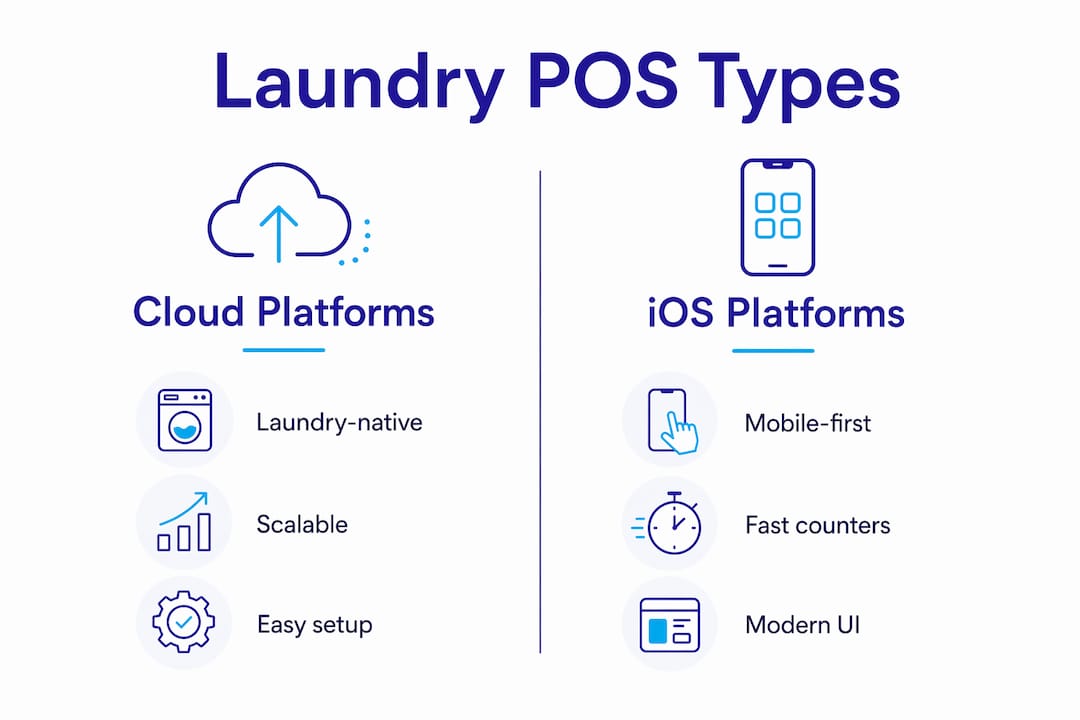
Here are the top categories of wash dry fold software alternatives worth evaluating:
- Laundry-native cloud platforms with integrated route management, driver apps, and customer SMS notifications
- Mobile-first iOS POS systems built for counter speed, Bluetooth scale pairing, and visual order tracking
- Enterprise-grade laundry management suites supporting multi-location garment transfers and commercial account billing
- Modular SaaS platforms offering customizable pricing models for dry cleaning, wash-and-fold, and commercial laundry workflows
- Self-service-focused systems with machine activation integration and remote monitoring for coinless laundromats
1. Key features to prioritize when selecting laundry POS alternatives
Not every POS feature matters equally for laundry operations. These are the ones that separate a genuinely useful system from one you’ll regret buying six months in.
- Weight-based billing linked to a commercial scale. If you offer wash-and-fold, this is non-negotiable. The system should connect to a commercial scale and apply different rate tiers for residential versus commercial accounts automatically.
- Integrated pickup-and-delivery logistics. Route management, driver apps, and automated customer notifications should live inside the POS, not bolt on through a third-party workaround. Fragmented logistics data is one of the fastest ways to lose customers and revenue.
- Garment tracking and order management. Barcode or tag printing, status updates through each workflow stage, and customer preference notes all reduce errors and disputes.
- Commercial-grade hardware compatibility. Consumer tablets and card readers aren’t built for laundromat humidity and lint. Look for Bluetooth scale and label printer support designed for the environment.
- Payment compliance and security. EMV card readers, contactless payment support, and per-device access controls protect both revenue and customer data.
- Accounting, marketing, and loyalty integrations. Unified integrations reduce manual data entry and give owners a cleaner picture of business performance.
- Fast staff training and a simple interface. High turnover is real in this industry. A system your attendants can learn in an afternoon pays for itself quickly.
2. Common challenges when upgrading from legacy laundry management systems
Switching POS systems is rarely as clean as the sales demo suggests. Here’s what actually slows owners down.
- Total cost of ownership surprises. Owners often focus on the monthly subscription and miss onboarding, training, and hardware costs. Those add up fast, especially for multi-location operations.
- Integration complexity. Connecting a new POS to existing payment processors, loyalty programs, or accounting tools can disrupt daily operations for weeks if the vendor doesn’t handle it well.
- Fragmented pickup-and-delivery data. Running delivery logistics through a separate app while the POS handles orders creates gaps in customer communication and reporting.
- Staff resistance to new workflows. Attendants comfortable with paper tickets often push back on digital systems. Without a genuinely simple interface, adoption stalls.
- Hardware incompatibility. A POS that requires proprietary terminals or doesn’t pair with your existing scale means additional hardware spend on top of software fees.
- Silent revenue leaks from manual gaps. Missed order-ready notifications, forgotten pickup calls, and manual billing errors quietly erode margins without showing up clearly on any report.
3. How to evaluate and select the right POS for your laundromat or dry cleaner
Start with your actual workflow, not the feature list in a vendor’s brochure.
- Map your current operations first. Identify where orders stall, where staff make errors, and where customers complain. That map tells you which POS features are truly essential versus nice to have.
- Calculate total cost of ownership. Add subscription fees, hardware costs, onboarding time, and ongoing support. Reliable customer service impacts long-term platform success more than most owners expect at purchase time.
- Verify native pickup-and-delivery support. Ask vendors specifically whether route management and customer notifications are built in or require a paid integration. The difference matters operationally.
- Test the interface with your actual staff. A system that looks clean in a demo can still be slow at the counter. Run a trial shift before committing.
- Confirm hardware compatibility. Check whether the POS pairs with your existing scale, printer, and payment terminal, or whether you’re buying a full new hardware bundle.
- Ask about support hours and response times. Laundromats often run early mornings and late evenings. A vendor with business-hours-only support is a liability if something breaks on a Saturday night.
- Prioritize platforms built for growth. If you plan to add locations or delivery routes, choose a system that handles multi-location management and customizable workflows without requiring a platform switch later.
4. Introducing Kansoflow: a modern native iOS POS for laundromats and dry cleaners
Kansoflow is built specifically for laundromat and dry cleaner owners who are done with browser-based systems that lag at the counter and paper tickets that disappear. It runs natively on iOS, which means the interface responds at the speed your counter actually operates.
- Visual Kanban board. Orders move through Wash, Fold, Dry Cleaning, and Ready stages on a drag-and-drop board. Attendants see the full floor at a glance without digging through menus.
- Photo intake at the counter. Every order gets photographed at drop-off, eliminating lost-item disputes before they start and building a record of customer garment preferences.
- Inter-branch garment transfers. Drop-off locations can route orders to processing hubs natively, with full tracking throughout. Third-party outsourcing is managed inside the same system.
- Bluetooth scale and Star Micronics printer pairing. Mobile-native POS platforms using standard iOS devices reduce training time and connect directly to commercial hardware without proprietary bundles.
- Per-device PIN security. Staff can lock or switch users in seconds at a busy counter, keeping access controls tight without slowing anyone down.
- Real-time reporting dashboards. Owners get a clear operational picture across locations without logging into separate tools.
Pro Tip: Switching to an integrated platform like Kansoflow eliminates the two biggest silent revenue leaks in laundry operations: missed order-ready notifications and manual billing errors. Both disappear when intake, tracking, and communication run through a single system.
5. How do top wash dry fold point of sale alternatives compare?
Choosing between laundry POS platforms comes down to which trade-offs fit your operation. Here’s how the main categories stack up.

| Feature category | Laundry-native cloud platforms | Mobile-first iOS platforms | Enterprise suites |
|---|---|---|---|
| Weight-based billing | Standard | Standard | Standard |
| Pickup-and-delivery integration | Built-in | Varies | Built-in |
| Hardware flexibility | Moderate | High (standard iOS) | Low (proprietary) |
| Staff training time | Moderate | Low | High |
| Multi-location support | Varies | Built-in | Strong |
| Monthly cost structure | Flat rate | Subscription | Contract-based |
Transitioning from paper-based management to an integrated digital POS reduces daily financial close time and eliminates status-update bottlenecks. The laundry management software market now spans cloud-based and on-premises options, with AI-driven analytics and IoT sensors entering the category, so the gap between entry-level and enterprise platforms is narrowing fast.
The practical difference between platforms often shows up in hardware flexibility. Proprietary terminal bundles lock you into a vendor’s pricing and replacement cycle. Platforms built on standard iOS devices let you use existing Apple hardware and swap components without a vendor call.
6. What to look for in customer support from a laundry POS provider
Support quality is the feature you only discover after you’ve signed up. Ask these questions before you commit.
A POS vendor’s support model should match your operating hours. If your store opens at 6 AM and closes at midnight, business-hours-only support means you’re on your own for the shifts that matter most. Look for vendors offering live chat, phone support, or at minimum a documented escalation path for critical issues.
Response time on software updates matters too. Vendor support evaluation should include how frequently the platform ships updates, whether updates break existing workflows, and whether training resources are updated alongside the software. A vendor that ships a major update with no documentation forces your staff to figure it out mid-shift.
Onboarding quality separates platforms that stick from ones that get abandoned. Ask whether live onboarding is included in the subscription or billed separately, and whether the vendor assigns a dedicated contact for your first 30 days. The total cost of ownership calculation should factor in the time your team spends getting up to speed, not just the software fee.
Try Kansoflow for your laundromat today
Kansoflow is the native iOS POS built for the realities of running a laundromat: fast counters, high staff turnover, and customers who expect order-ready texts, not phone calls. Explore the full platform features or visit kansoflow.com to see how it fits your operation.
Key Takeaways
Purpose-built laundry POS platforms outperform generic retail systems because they handle weight-based billing, garment tracking, and pickup-and-delivery logistics natively, without workarounds.
| Point | Details |
|---|---|
| Laundry-specific features matter | Generic POS systems lack weight-based billing and garment tracking, forcing costly workarounds. |
| Total cost of ownership | Onboarding, training, and hardware costs often exceed the subscription fee; calculate all three upfront. |
| Pickup-and-delivery integration | Native route management and automated notifications reduce fragmented data and missed communications. |
| Hardware compatibility | Platforms using standard iOS devices offer more flexibility than proprietary terminal bundles. |
| Support quality | Vendor response time and onboarding quality determine long-term platform success more than feature lists. |