Laundromat Service Tier Pricing Explained for Owners
Laundromat service tier pricing is the structured practice of charging different rates for different service levels, from self-service coin machines to full pickup and delivery, so that each tier covers its true cost and returns a margin. Most operators in 2026 run at least three distinct tiers: self-service, wash-and-fold, and specialty or premium services. Standard wash-and-fold rates in the U.S. run $1.25–$2.50 per pound, with same-day surcharges of 25%–50% on top. Getting laundromat service tier pricing explained correctly from the start is the difference between a business that grows and one that grinds.
What are the common pricing tiers in laundromats?
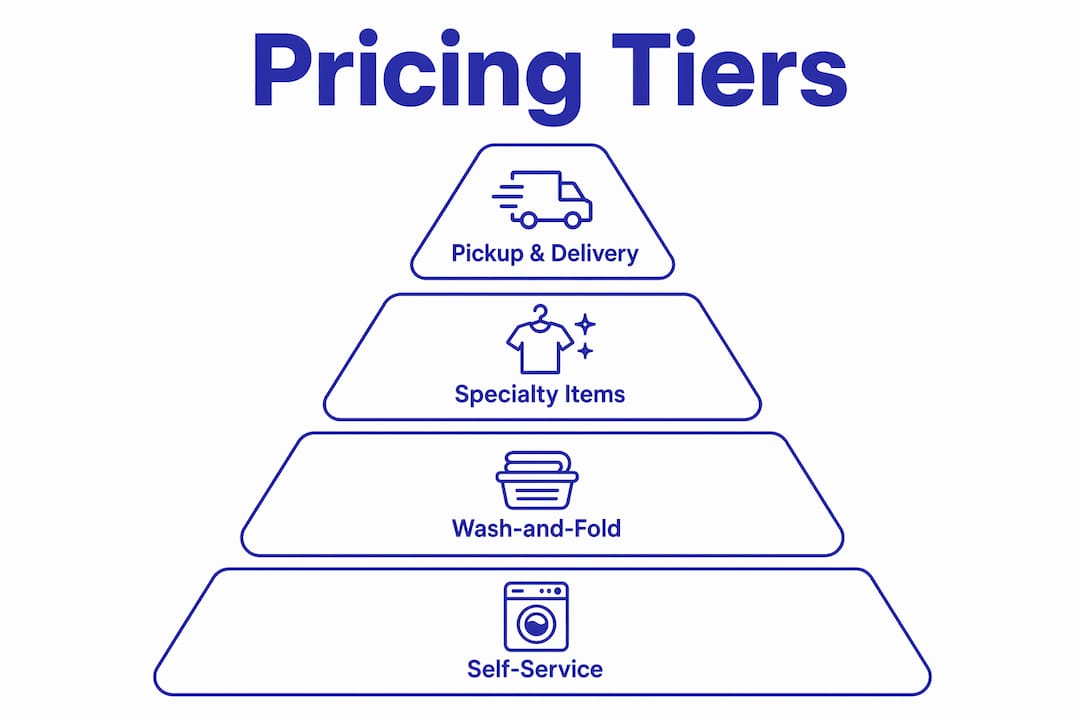
Laundromat pricing tiers fall into four clear categories, each with its own billing unit, cost driver, and customer value proposition. Knowing where each tier sits helps you price with purpose rather than guessing at what the market will bear.
Self-service is the foundation of most laundromats. Pricing is based on machine capacity per load. Self-service load pricing runs roughly $3.75 for a 20 lb machine, $5.25 for a 40 lb machine, and $8.50 for a 60 lb machine, with dryers adding about $1.25 per cycle. That structure means a customer doing a large load in a 60 lb washer plus two dryer cycles pays around $10.00 before any extras. The billing unit is the load, not the pound, so your revenue scales with machine size rather than garment count.

Wash-and-fold is where most operators build their real margin. Billing shifts to weight, and the industry standard sits at $1.25–$2.50 per pound. Minimums matter here. Most operators set a minimum dollar order of $15–$25 to block small, labor-heavy loads that eat into profit. Recurring commercial accounts, such as gyms, salons, and Airbnb hosts, often qualify for volume discounts or subscription rates that lock in predictable revenue.
Specialty items require per-piece pricing. Comforters, duvets, and sleeping bags demand individual handling, and specialty item pricing per piece is the only way to stay profitable on these orders. A comforter that weighs 8 pounds at $1.75 per pound would bill at $14.00 under weight pricing, but the actual labor and machine time may justify $25–$35 per piece. Per-piece billing captures that reality.
Pickup and delivery sits at the top of the pricing pyramid. Premium tiers like pickup and delivery command higher per-pound rates because the convenience factor is the product. Recurring subscription pricing works especially well here, locking customers into weekly or biweekly service.
| Service tier | Billing unit | Typical price range | Core value driver |
|---|---|---|---|
| Self-service | Per load | $3.75–$8.50 per load | Speed, machine access |
| Wash-and-fold | Per pound | $1.25–$2.50 per pound | Time savings, labor |
| Specialty items | Per piece | $15–$45 per piece | Handling expertise |
| Pickup and delivery | Per pound + fee | $2.00–$3.50 per pound | Maximum convenience |
How do laundromats calculate prices by weight, load, and item?
Weight-based billing is the backbone of wash-and-fold pricing, and accuracy is non-negotiable. Customer estimates differ from actual weight by 30%–50%, which means relying on a customer’s guess costs you real money on every order. A commercial scale at intake is the only reliable billing reference. Billing always uses the facility’s commercial scale, never the customer’s estimate.
Laundromat garment weight billing works best when the weight is captured at the moment of intake and linked immediately to the order record. This is where technology closes the gap. Advanced operators use POS systems that print barcode tags connecting each bag to its recorded weight, so there is no ambiguity at pickup and no room for disputes.
Self-service load pricing operates differently. The billing unit is the machine cycle, not the pound. A customer loading a 40 lb washer pays for that machine’s cycle regardless of whether the drum is half full or packed. That simplicity is the point. No weighing, no calculation, no staff involvement.
Per-piece billing for specialty items requires a published price list posted at the counter and available online. Customers need to know before they drop off that a comforter is $30, not calculated by weight. Clear communication at intake eliminates the most common source of disputes in specialty service.
Pro Tip: Use a Bluetooth-connected commercial scale paired with your POS system to capture weight at intake and print a tagged receipt in one motion. This cuts counter time and eliminates the “I only had 8 pounds” argument at pickup.
Here is what accurate weight-based billing requires in practice:
- A certified commercial scale at every intake counter
- Weight captured and recorded at drop-off, not at processing
- Barcode or tag linking the weight record to the specific order
- A posted minimum order policy ($15–$25) visible to customers before they hand over laundry
- Staff trained to explain the billing basis in one sentence
What operational factors drive tier pricing and profitability?
Labor cost is the biggest variable separating self-service from full-service tiers. Self-service requires almost no labor per order. Wash-and-fold requires sorting, washing, drying, folding, and bagging, which adds 15–25 minutes of staff time per order depending on load size. That labor cost must be priced in, not absorbed.
Same-day service is the clearest example of a surcharge that customers accept willingly. A 25%–50% same-day premium is standard, and it reflects real staffing cost. Offering same-day without a surcharge trains customers to expect it for free, which destroys your margin on the busiest days of the week.
Batch processing is a profitability lever most operators underuse. Machines with 30–80 lb capacity reduce labor hours per pound by processing multiple orders in a single cycle. A 60 lb washer running three 20 lb orders simultaneously cuts your labor cost per pound by a factor of three compared to running each order separately in a top-loader. That efficiency gap is why equipment investment pays back faster than most operators expect.
Turnaround guarantees also affect pricing. A 24-hour guarantee is a service commitment, and customers pay for commitments. Operators who offer vague “next day or so” timelines cannot charge premium rates because they are not delivering a premium promise.
Pro Tip: Price specialty items like comforters and sleeping bags separately from your standard wash-and-fold menu. Post the per-piece rates on a laminated card at the counter. Customers who see the price before drop-off almost never dispute it at pickup.
Here is how to structure your operational pricing decisions:
- Calculate your actual labor cost per pound for wash-and-fold before setting any rate.
- Set same-day surcharges at a minimum of 25% above your standard rate.
- Identify which machines in your facility support batch processing and route wash-and-fold orders through them first.
- Publish turnaround time guarantees in writing, and price tiers that include faster turnaround at a premium.
- Review specialty item pricing quarterly, since labor costs shift with minimum wage changes and staffing levels.
How can owners implement a tiered pricing system effectively?
Implementing a tiered pricing system starts with local market research. Visit three to five competitors within your trade area and document their posted rates for each service type. The lowest per-pound rate is not always most profitable; consistency, turnaround speed, and packaging quality justify premium pricing and higher margins. Price to your service quality, not to the cheapest option in your zip code.
Transparent communication is the second pillar. Weighing bags at intake and confirming the final charge before washing builds customer trust and cuts disputes by a significant margin. Post your per-pound rate, your minimum order, and your surcharge policy at the counter, on your website, and in any confirmation text or email you send. Customers who understand the pricing model before they commit almost never challenge the final bill.
POS and management software makes multi-tier pricing manageable at scale. A system that handles per-pound billing, per-piece billing, same-day surcharges, and subscription accounts in a single interface removes the math from your staff’s hands and puts it in the system. Real-time price adjustments, such as a holiday surcharge or a promotional rate for new customers, become a settings change rather than a retraining exercise. You can explore how laundry POS features support these configurations without adding counter complexity.
Marketing premium tiers requires a different message than marketing self-service. Self-service customers want speed and machine availability. Wash-and-fold and pickup-and-delivery customers are buying time back. Your marketing for premium tiers should lead with the time savings and the reliability of the turnaround guarantee, not the price per pound.
Customer education reduces friction at every touchpoint. A short explanation on your drop-off receipt, a FAQ card at the counter, and a clear confirmation message before processing all reduce the number of customers who are surprised by their final charge. Surprise is the enemy of repeat business.
| Implementation step | Tool or method | Goal |
|---|---|---|
| Local pricing research | In-person visits, competitor websites | Set competitive but profitable rates |
| Transparent intake | Commercial scale, posted rate card | Eliminate billing disputes |
| POS configuration | Multi-tier billing software | Accurate charges across all service types |
| Premium tier marketing | Social media, in-store signage | Drive higher-margin service adoption |
| Customer education | Counter cards, confirmation messages | Reduce disputes and improve retention |
Key takeaways
Laundromat service tier pricing works when each tier is priced to its true labor cost, billed on the right unit, and communicated clearly to customers before the order is processed.
| Point | Details |
|---|---|
| Four core tiers | Self-service, wash-and-fold, specialty items, and pickup/delivery each require a different billing unit and rate. |
| Weight billing accuracy | Use a commercial scale at intake and link weight to a barcode tag to eliminate disputes and protect margin. |
| Minimum order policy | Set a $15–$25 minimum dollar order to block unprofitable small loads from entering the wash-and-fold queue. |
| Same-day surcharges | Charge 25%–50% above standard rates for same-day service to cover real staffing costs. |
| Technology as the enforcer | A POS system that handles per-pound, per-piece, and subscription billing removes pricing errors from staff judgment. |
Why most operators underprice their best tiers
I have seen operators run a tight self-service floor and a profitable wash-and-fold operation, then quietly lose money on pickup and delivery because they priced it like wash-and-fold with a small delivery fee tacked on. That math never works. Pickup and delivery is a logistics operation layered on top of a laundry operation, and it needs to be priced that way.
The other mistake I see constantly is treating the per-pound rate as the only pricing lever. It is not. Minimums, surcharges, per-piece specialty rates, and subscription structures are all pricing levers, and most operators leave at least two of them untouched. A $1.75 per-pound rate with a $20 minimum and a 35% same-day surcharge generates more revenue per order than a $2.10 rate with no minimum and no surcharge policy.
The operators who grow fastest are not the ones with the lowest prices. They are the ones who automate back-office pricing workflows so that every tier is enforced consistently, every surcharge is applied automatically, and every customer gets the same clear intake experience regardless of which staff member is at the counter. Consistency is what turns a pricing structure into a pricing system.
The future of laundromat pricing is moving toward subscription models for recurring customers and dynamic surcharges for peak-demand windows. Operators who build that flexibility into their POS now will not need to retrain staff or reprint menus when the market shifts.
— Artur
How Kansoflow supports tiered pricing management
Running multiple service tiers without the right software means your staff is doing mental math at the counter during your busiest hours. Kansoflow is built specifically for laundromat operators who need per-pound billing, per-piece billing, same-day surcharges, and subscription accounts managed in one place on a standard iOS device.

Kansoflow pairs natively with Bluetooth scales and Star Micronics tag printers, so weight capture and order tagging happen in a single counter motion. The visual Kanban board tracks every order through Wash, Fold, Dry Cleaning, and Ready stages, giving your team real-time visibility without paper tickets. Photo intake at drop-off eliminates lost-item disputes before they start. If you are ready to put your tiered pricing into a system that enforces it automatically, Kansoflow is built for exactly that operation.
FAQ
What is laundromat service tier pricing?
Laundromat service tier pricing is the practice of charging different rates for different service levels, such as self-service, wash-and-fold, specialty items, and pickup/delivery, with each tier priced to its actual labor and convenience cost.
How is wash-and-fold pricing calculated?
Wash-and-fold pricing is calculated by weight using a commercial scale at intake. Standard U.S. rates run $1.25–$2.50 per pound, with most operators requiring a minimum order of $15–$25.
Why do laundromats charge per piece for specialty items?
Specialty items like comforters and sleeping bags require individual handling that makes weight-based billing unprofitable. Per-piece pricing captures the actual labor and machine time each item demands.
What is a same-day service surcharge?
A same-day surcharge is an additional fee of 25%–50% above the standard rate, applied when a customer needs their order completed the same day. It covers the staffing cost of prioritizing that order over the standard queue.
How does a POS system help manage laundromat pricing tiers?
A laundromat POS system automates per-pound, per-piece, and subscription billing so that every tier is applied consistently without staff calculation. Systems like Kansoflow also link weight data to barcode tags at intake, reducing disputes and lost orders.