Laundromat Garment Cataloging: A Practical Owner’s Guide

Laundromat garment cataloging is the process of assigning a unique, trackable identity to every laundry item so it can be monitored through each stage of the wash, dry, fold, and dispatch workflow. In the laundry industry, this practice is formally called garment lifecycle management, and it goes far beyond labeling. RFID-enabled operations assign a unique digital identity per garment, linking each piece to metadata stored in management software. The result is real-time inventory visibility, fewer lost items, and a customer service record that holds up when disputes arise. If you run a laundromat and still rely on paper tickets or manual counts, understanding what is laundromat garment cataloging is the first step toward fixing your biggest operational blind spots.
What is laundromat garment cataloging and how does it work?
Garment cataloging is a structured system for recording and tracking each washable item as an accountable asset. The industry standard technology behind it is RFID, which stands for Radio Frequency Identification. Each garment receives a small RFID tag that stores a unique identifier. That identifier links to a digital record containing the garment’s owner, type, wash history, and current location in the workflow.
RFID systems read tagged garments automatically at multiple checkpoints without requiring staff to scan each item individually. This is the critical difference from barcode systems. A barcode requires line-of-sight scanning. An RFID reader captures dozens of tags simultaneously as garments pass through a tunnel or gate. That speed is what makes cataloging practical at laundromat scale.
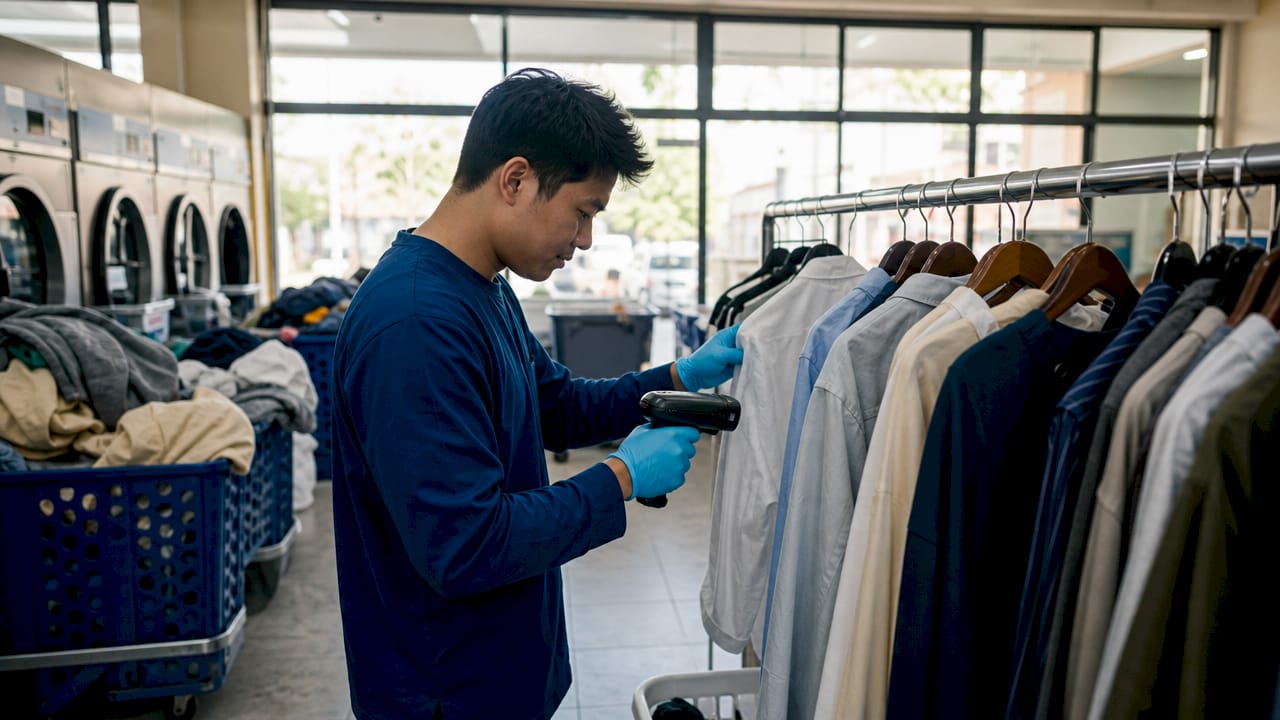
The garment record updates every time a tag passes a reader. A customer drops off a bag of shirts. The receiving dock reader logs them in. The sorting station reader confirms they entered the right wash group. The washing machine exit reader confirms they came out. Each read creates a timestamped event in the software. The garment’s full journey becomes a documented history, not a guess.
Software that interprets RFID reads into structured lifecycle events is what separates a true cataloging system from a faster barcode scanner. Without management software, RFID is just a counting tool. With it, you get wash counts, customer ownership records, loss alerts, and delivery confirmation in one dashboard.
How RFID checkpoints move garments through your workflow
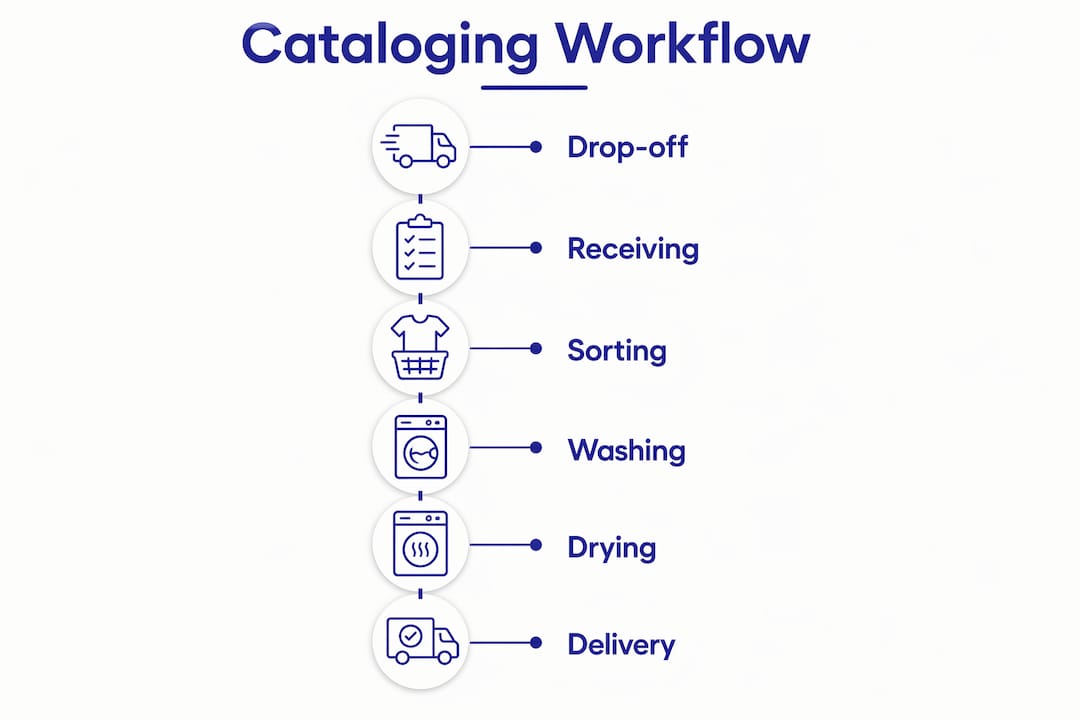
A well-designed cataloging system places RFID readers at every stage where garments change hands or status. The sequence below reflects how high-performing laundromats structure their read points.
- Collection and intake. The customer drop-off point is the first read. Every tagged garment is logged into the system with the customer’s account, the order number, and the intake timestamp.
- Sorting station. Garments are separated by wash type, color, or customer group. A reader at this station confirms which items entered each sort category and flags any that were misrouted.
- Washing and drying exits. Readers positioned at machine exits confirm that every garment that went in came back out. This is where most loss events are caught before they become customer complaints.
- Folding and packaging. A read at this stage confirms the garment has been processed and links it to the completed order record.
- Dispatch. The final read confirms that the correct items left the facility with the correct customer or delivery route.
Tunnel readers can process over 1,000 items per hour, enabling automated sorting at a pace no manual team can match. That throughput means cataloging does not slow your operation. It runs alongside it.
Pro Tip: Place a reader at your sorting station before you invest in tunnel hardware. Sorting is where misrouting happens most often, and catching errors there costs far less than tracing a lost garment after delivery.
Benefits of garment cataloging for inventory and customer service
The operational case for a garment tracking system is direct. Cataloging solves three problems that cost laundromat owners money every week: lost items, manual counting labor, and customer disputes.
- Immediate loss detection. Tunnel readers flag missing items in real time rather than after delivery. You know a shirt is missing before the customer picks up their order, which gives you time to find it.
- Labor reduction. Automated counting at each checkpoint replaces manual tallies. Staff spend less time counting and more time on customer-facing tasks.
- Customer trust. When a customer asks where their garment is, you can pull up a timestamped record showing exactly where it is in the workflow. That answer builds confidence in your service.
- Lifecycle reporting. Each garment’s wash count is logged. You can identify items approaching end of life and plan replacements before they become a quality issue.
- Reorder planning. Inventory reports show which items are in circulation, which are lost, and which are ready for retirement. Reorder decisions become data-driven rather than reactive.
Defining the cataloging unit — whether you track per garment, per bag, or per customer group — determines how granular your inventory data becomes. Item-level tracking gives you the fastest notification of missing pieces. Bag-level tracking is simpler to set up but gives you less precision. The right choice depends on your volume and the expectations of your customers.
Cataloging also changes how you handle disputes. Without a record, a lost-item claim becomes a he-said-she-said situation. With a cataloging system, you have a documented chain of custody. That documentation protects your business and shortens the time you spend resolving complaints.
Challenges and best practices in deploying garment cataloging
The most common reason garment cataloging systems underperform is not the technology. It is the deployment. Operational mismatches, signal interference, and environmental factors frequently cause failure in garment tracking systems that were technically sound on paper.
- Signal interference. Metal surfaces and water-heavy environments reduce RFID read accuracy. Reader placement must account for the physical environment of your specific facility.
- Dead reading zones. Areas where garments pile up or move in bulk can create gaps in coverage. Mapping your floor plan before installation prevents these gaps.
- Tag orientation. Some RFID tags read poorly when folded or compressed. Choosing tags designed for textile applications and testing their read rates in real wash conditions is non-negotiable.
- Tag durability. RFID laundry tags must withstand washing temperatures and harsh chemicals. Tags are sewn, heat-sealed, or iron-on, and the attachment method must match the textile type. A tag that fails after 20 washes defeats the purpose of the system.
- Software integration gaps. Raw RFID reads are not inventory data. Without software that converts reads into lifecycle events, you have a faster counting tool, not a cataloging system.
Pro Tip: Run a pilot with 200–300 tagged garments before committing to a full deployment. A small pilot exposes read-rate problems, tag failures, and workflow mismatches at a fraction of the cost of a full rollout.
Workflow alignment is the factor most owners underestimate. Cataloging design must match actual textile movement in daily operations, not an idealized process map. Walk your floor, observe how garments actually move, and design your reader placement around that reality.
How to start your laundromat garment cataloging process
Getting a cataloging system running does not require a complete overhaul of your operation. A phased approach reduces risk and lets you validate each step before moving to the next.
- Assess your current pain points. Identify where garments go missing, where manual counting slows your team, and where customer disputes originate. These are your priority areas for cataloging coverage.
- Choose your cataloging unit. Decide whether you will track at the item level, bag level, or customer group level. Item-level tracking gives the most control. Bag-level tracking is faster to implement.
- Select RFID tags matched to your textiles. Work with a tag supplier to match tag format and attachment method to your garment types and wash conditions. Test durability before ordering in volume.
- Map your workflow and place readers. Draw your floor plan and mark every point where garments change hands or status. Place readers at those points. Prioritize intake, sorting, and dispatch if budget requires a phased hardware rollout.
- Integrate or upgrade your management software. Your software must convert RFID reads into inventory events. A laundry management platform with built-in cataloging support eliminates the need for custom middleware and reduces setup time.
- Train your staff and monitor performance. Staff training determines whether your system runs as designed. Set a review schedule for the first 90 days to catch read-rate drops, tag failures, or workflow gaps before they compound.
| Step | Focus area | Key output |
|---|---|---|
| Assess pain points | Operations audit | Priority list of problem areas |
| Choose cataloging unit | System design | Tracking granularity decision |
| Select RFID tags | Hardware | Tags matched to textile and wash type |
| Map workflow and readers | Floor planning | Reader placement diagram |
| Integrate software | Technology | Live inventory dashboard |
| Train and monitor | People and process | Ongoing system reliability |
Key Takeaways
Garment cataloging works because RFID tags, strategically placed readers, and management software together create a documented chain of custody for every item in your laundromat.
| Point | Details |
|---|---|
| Cataloging is lifecycle management | Tracking garments through every stage treats each item as an accountable asset, not just a named object. |
| RFID checkpoints drive accuracy | Readers at intake, sorting, washing exits, and dispatch catch losses before they reach the customer. |
| Software converts reads into data | Without management software, RFID reads are counts. With it, they become inventory history and loss alerts. |
| Tag selection determines durability | Tags must match textile type and wash conditions. A failing tag breaks the chain of custody. |
| Phased deployment reduces risk | Starting with 200–300 tagged garments exposes problems before a full rollout commits your full budget. |
The part most owners get wrong about cataloging
Running a laundromat means you are already managing more variables than most retail businesses. Garments come in from dozens of customers, move through multiple machines, and go back out on tight turnaround times. I have seen owners invest in RFID hardware and then wonder why their loss rate barely moved. The answer is almost always the same: they treated cataloging as a scanning upgrade rather than a process redesign.
The technology is the easy part. A tag costs cents. A reader is a one-time hardware purchase. What actually determines whether cataloging pays off is whether your workflow is designed around the system or the system is bolted onto a workflow that was never built for it. If your sorting process is inconsistent, RFID will document that inconsistency in detail. It will not fix it.
The owners who get the most out of garment cataloging are the ones who use the data to change behavior. They look at which wash stage produces the most missing-item alerts and redesign that step. They use lifecycle reports to catch garments that are degrading before a customer notices. They pull customer ownership records when a dispute comes in and close it in two minutes instead of two days. That is what cataloging is actually for. The scan is just the beginning.
My honest advice: do not wait until you have a perfect system designed before you start. Tag your highest-value items first. Put a reader at your intake counter. Get your staff used to the process. The data you collect in the first 60 days will tell you exactly where to invest next.
— Artur
Kansoflow and the garment cataloging workflow
Kansoflow is a native iOS laundry POS and management platform built for independent and multi-location laundromat owners who need real-time visibility without the complexity of legacy systems.

The platform’s Photo Intake feature captures garment images at the counter the moment a customer drops off an order. That photo becomes part of the garment record, giving you visual documentation alongside the digital catalog entry. The Visual Kanban Board tracks every order through Wash, Fold, Dry Cleaning, and Ready stages in real time, so your team always knows where each item stands. For owners managing multiple locations, Kansoflow supports inter-branch garment transfers and third-party outsourcing, keeping your inventory management connected across every site. If you are ready to replace paper tickets and manual counts with a system built for the shop floor, Kansoflow is worth a close look.
FAQ
What is garment cataloging in a laundromat?
Garment cataloging is the process of assigning a unique digital identity to each laundry item and tracking it through every stage of the wash, dry, fold, and dispatch workflow. It gives laundromat owners real-time inventory visibility and a documented chain of custody for every piece.
What technology does laundromat garment cataloging use?
RFID is the standard technology for garment cataloging in laundromats. Tags attached to garments are read automatically at multiple workflow checkpoints, updating inventory records without manual scanning.
How does garment cataloging reduce lost items?
RFID readers at washing and drying exits flag missing items immediately rather than after delivery. That real-time alert gives staff time to locate the garment before the customer arrives for pickup.
Do I need special software for garment cataloging?
Yes. RFID hardware alone only produces raw read data. Management software converts those reads into structured inventory events, wash histories, customer ownership records, and loss reports that make cataloging operationally useful.
What is the best way to start cataloging garments in my laundromat?
Start with a pilot of 200–300 tagged garments focused on your highest-loss items or most complex workflow stage. Use the pilot data to identify read-rate gaps and workflow mismatches before committing to a full deployment.