Laundromat Counter Speed Best Practices for 2026

Counter speed is the single most measurable driver of customer retention in a laundromat. Operators who apply laundromat counter speed best practices consistently target average wait times under 10 minutes during peak hours, a benchmark that reduces customer abandonment by 40–60%. The industry term for this discipline is throughput management, and it covers everything from payment systems and staff workflows to machine scheduling and KPI tracking. Get it right, and you keep customers. Get it wrong, and they walk out before the spin cycle ends.
1. Laundromat counter speed best practices start with payment modernization
The fastest single upgrade any operator can make is eliminating coin-only payment. Transitioning to digital payments boosts revenue by 20–35% within one year. Faster transactions and reduced theft both contribute to that gain.
The placement of payment terminals matters just as much as the technology itself. Centralized POS terminals slow counter speed because customers must pay at one station, then walk back to their machine. Moving payment directly to the washer or dryer removes that bottleneck entirely. Customers load, pay, and start without ever forming a line at the counter.
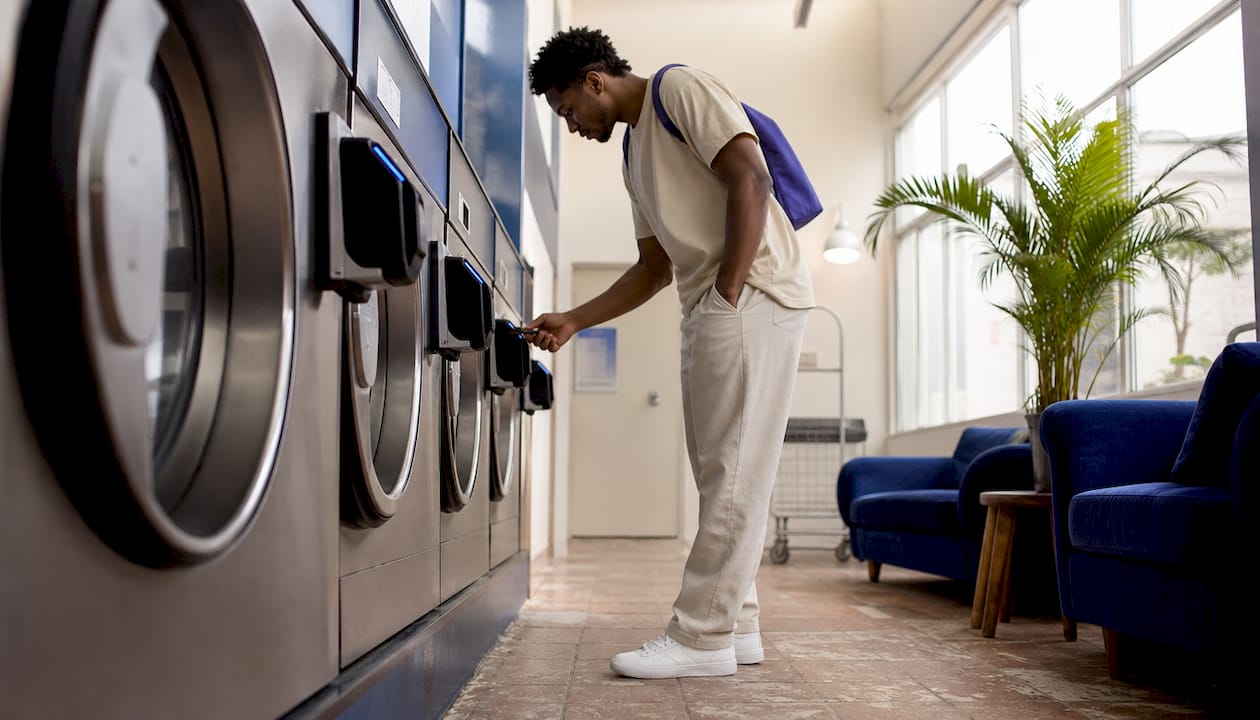
Modern payment systems also generate detailed usage data. That data unlocks targeted promotions and loyalty programs that keep customers coming back without any extra counter interaction.
Pro Tip: Install card readers at every machine rather than one central kiosk. The upfront cost is higher, but the reduction in counter congestion pays for itself within a few months.
2. How automation cuts wait times and service variance
Automation is not about replacing attendants. It is about removing the repetitive tasks that slow them down. Automated order status notifications reduce staff response times by 60% and lower service variance by 45%. That means fewer customers crowding the counter to ask “Is my order ready?”
When customers receive a text or app notification at pickup time, they arrive at the counter prepared. The transaction takes seconds instead of minutes. Staff can focus on intake accuracy and customer care rather than fielding status questions all day.
AI-driven capacity planning takes this further. It predicts peak load windows and triggers staffing adjustments before the rush hits, not after the line forms. That proactive posture is what separates high-throughput shops from average ones.
3. Staff training methods that actually improve counter flow
Hiring for reliability and customer care beats hiring for raw speed. A sloppy fold drives customers away faster than a slower turnaround. Speed without accuracy creates disputes, refunds, and lost regulars.
The most effective intake process follows three steps:
- Weigh the laundry in front of the customer. Recording the weight on the ticket provides transparency and prevents disputes before they start.
- Tag every bag clearly with the customer’s name, phone number, and drop-off time. Ambiguous tags are the root cause of most mix-ups.
- Confirm the turnaround time out loud. Setting a realistic expectation at intake eliminates the follow-up calls that clog the counter later.
Pro Tip: Train attendants to repeat the pickup time back to the customer before they leave. That one habit cuts “where’s my order?” calls by a significant margin.
4. Single-attendant ownership reduces handoff errors
Assigning one attendant to manage a wash-and-fold order from drop-off to pickup is the most underused workflow fix in the industry. Handoffs are the primary failure point in any service operation. Every time an order changes hands, the risk of a mix-up increases.
Single-attendant ownership creates accountability. The attendant who took the order knows exactly where it is, what was agreed, and when it is due. That knowledge lives in one person’s head rather than scattered across a shift change.
This model also speeds up the counter during pickup. The attendant retrieves the order without hunting through a rack of unlabeled bags. The customer is in and out in under two minutes.
5. Layout and machine scheduling that protect throughput
Counter bottlenecks rarely come from machine capacity alone. Bottlenecks arise when drop-off loads overlap with peak self-service hours, tying up dryers and fold tables simultaneously. The fix is scheduling, not more equipment.
Reserve dedicated machines for drop-off orders during off-peak hours. This keeps promised turnaround times intact without pulling machines away from self-service customers during busy periods. A practical capacity target is a peak-to-off-peak utilization ratio near 3:1, meaning your shop handles roughly three times the load at peak versus slow periods without service degrading.
Counter area design also affects speed. Payment locations, intake stations, and pickup shelves should form a logical path that customers can follow without backtracking. Every extra step a customer takes is a second added to the transaction.
6. KPIs every operator should track for counter efficiency
Turns Per Day per washer is the primary measure of machine utilization. The target is 4–6 turns per washer daily. Operators who fall below 4 turns consistently have a scheduling or bottleneck problem, not a demand problem.
The KPIs that matter most for efficient laundromat operations are:
- Average wait time during peak hours. Target under 10 minutes. Anything above that signals a counter or machine flow problem.
- Customer abandonment rate. Track how often customers leave without completing a transaction. Even a rough estimate from security footage is useful.
- Labor cost as a percentage of revenue. Staffing levels must pay for themselves. If labor exceeds a healthy share of revenue, the workflow needs adjustment before adding headcount.
- Revenue per machine. This metric connects machine utilization directly to income and shows which equipment earns its floor space.
Tracking these numbers weekly gives operators the data to make decisions before problems compound. Gut feel is not a KPI.
7. Balancing speed with service quality to retain customers
Speed without quality is a short-term win and a long-term loss. Customers who receive a fast but careless fold do not return. The goal is a fast and accurate transaction, not one at the expense of the other.
Setting realistic turnaround promises at intake is the most direct way to protect both. Over-promising a two-hour turnaround when the shop is at capacity creates a failure that no amount of speed can fix. A four-hour promise that is delivered in three hours builds trust.
Communication automation handles the middle ground. Automated pickup reminders and order-ready notifications keep customers informed without pulling attendants away from the counter. The customer feels cared for. The attendant stays focused on the next intake.
Prioritizing service quality over pure speed is what differentiates a laundromat with loyal regulars from one that competes only on price. Accuracy in intake and folding is as important as transaction speed for long-term customer retention.
Key Takeaways
The most effective laundromat counter speed practices combine digital payment placement, single-attendant order ownership, and KPI tracking to cut wait times and protect service quality simultaneously.
| Point | Details |
|---|---|
| Move payment to the machine | In-machine card readers eliminate counter lines and reduce abandonment. |
| Assign one attendant per order | Single-attendant ownership cuts handoff errors and speeds up pickup. |
| Track Turns Per Day weekly | Target 4–6 turns per washer daily to identify scheduling bottlenecks early. |
| Schedule drop-off orders off-peak | Reserving machines during slow periods protects turnaround promises. |
| Hire for care, train for speed | Accuracy in folding retains customers longer than fast but sloppy service. |
What I’ve learned about counter speed after watching hundreds of laundromats
Most operators I talk to focus on the wrong bottleneck. They buy more machines or hire more staff, but the real slowdown is almost always in the handoff: the moment between intake and pickup where information gets lost, bags get mislabeled, and customers get frustrated.
The operators who run the tightest shops do three things consistently. They weigh laundry in front of the customer every single time. They assign one person to own each order end to end. And they track Turns Per Day every week without exception. Those three habits alone separate a shop doing $8,000 a month from one doing $15,000 with the same equipment.
Technology matters, but it amplifies good process. A digital POS on top of a broken intake workflow just creates faster chaos. Get the workflow right first. Then layer in automation, digital payments, and notification systems to multiply what already works.
The operators who resist digital payments because “my customers use coins” are leaving real money on the table. The data from card transactions alone is worth the upgrade. You learn which machines are underused, which hours are actually your peak, and which customers are your regulars. That information changes how you schedule, staff, and market.
— Artur
How Kansoflow supports faster counter operations
Running a tight counter requires tools that keep up with the pace of a busy shop floor.

Kansoflow is a native iOS POS and management platform built specifically for laundromat operators. Its Visual Kanban Board lets attendants track every order through Wash, Fold, and Ready stages at a glance, with no paper tickets and no lost bags. Photo Intake captures garment condition at drop-off, eliminating dispute conversations that slow the counter. Bluetooth scale integration and Star Micronics tag printing connect directly to the intake workflow, so weighing and tagging happen in one motion. Stripe and Square payment integration means digital payments are live on day one. For operators managing multiple locations, inter-branch transfer tracking keeps drop-off and processing hubs in sync without phone calls.
FAQ
What is a good average wait time for a laundromat?
The 2026 industry benchmark is under 10 minutes during peak hours. Wait times above that level correlate with measurably higher customer abandonment rates.
How does digital payment improve counter speed?
In-machine card and mobile payment removes the need for customers to visit a central counter to pay. That single change eliminates the most common source of counter congestion in self-service laundromats.
What is Turns Per Day and why does it matter?
Turns Per Day measures how many wash cycles a single machine completes in a day. The target is 4–6 turns per washer. Operators below that range typically have a scheduling or workflow bottleneck, not a demand shortage.
How do I reduce lost-order disputes at the counter?
Weigh laundry in front of the customer, record the weight on the ticket, and assign one attendant to manage the order from drop-off to pickup. These three steps eliminate most disputes before they start.
Does automation replace counter staff?
Automation handles status notifications and routine communication, not customer interaction. It reduces the volume of status questions attendants field, freeing them to focus on intake accuracy and service quality.